


Transcript
Have you ever looked for a pack of pan scourers or a bottle of kitchen cleaner in the cupboard under the sink and just can’t find them? You know they’re there – well, you’re almost certain they are there – and yet inside the cupboard it’s too dark, too busy – or your arm just can’t stretch far enough.
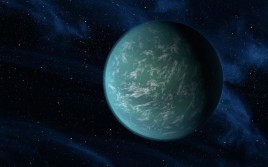
This is where household chores meet the cutting edge in space research. The search for planets beyond the control of our Sun, or exoplanets, is very similar to a hunt for a bottle of bleach in the kitchen cupboard. These planets are many light-years away, the light from their suns is so faint that we can hardly see them. When we listen for them, there’s all sorts of other noise we have to cut through. And yet NASA’s Kepler mission last year made some remarkable discoveries. Remember those images in the newspaper of the Star Wars world Tattoine, the planet with two suns? That’s Kepler-16b, 200 light years from us earthlings. Or maybe you remember the planet said to be in the “Goldilocks zone” of its own solar system – not too hot and not too cold, Kepler 22-b could comprise the perfect conditions for life. In this podcast, as you’ve probably guessed, I’m on the hunt for exoplanets. So I have to start with Kepler, which is a pretty special little spacecraft.
Giovanna Tinetti: It has provided us with really a lot of new planets, especially very small ones compared to the maybe more massive ones that were found in the past. On top of that, Kepler has announced more than 1,000 planetary candidates which are at the moment awaiting confirmation.
AS: That’s Dr. Giovanna Tinetti, who’s one of the exoplanet searchers hunting through a treasure trove of planets found by Kepler.
GT: Kepler is also providing again a lot of statistics and is telling us, for instance, that exoplanets seem to be much more common than we thought at the beginning, so there is this flood of planets that we are receiving so it looks like this number is increasing exponentially, so that’s really very interesting and exciting.
AS: But Giovanna’s work is different to that of Kepler. I went along to the Department of Physics & Astronomy at University College London to ask her how. Your work doesn’t focus on what Kepler’s doing. I understand that you’re looking at atmospheres in the different planets, so can you tell us the difference in how Kepler goes about its mission and how you go about your mission?
GT: Kepler is a mission that is supposed to detect a new planet, so really find a new planet in the neighbourhood of our own sun, so a basic orbiting star which are relatively close to our own sun.
I’m very interested in finding new planets, don’t get me wrong, but what I’m particularly interested in is trying to understand the composition, and what they’re made of and trying to characterise. At the moment, we have been able to do this kind of characterisation through measurements for planets which are much more massive than on Earth. In particular we did a lot of measurements using Spitzer Space Telescope or Hubble SpaceTelescope and more recently even from the ground, looking at gas giant planets similar to our own Jupiter, but located close to the star, so relatively quite hot.
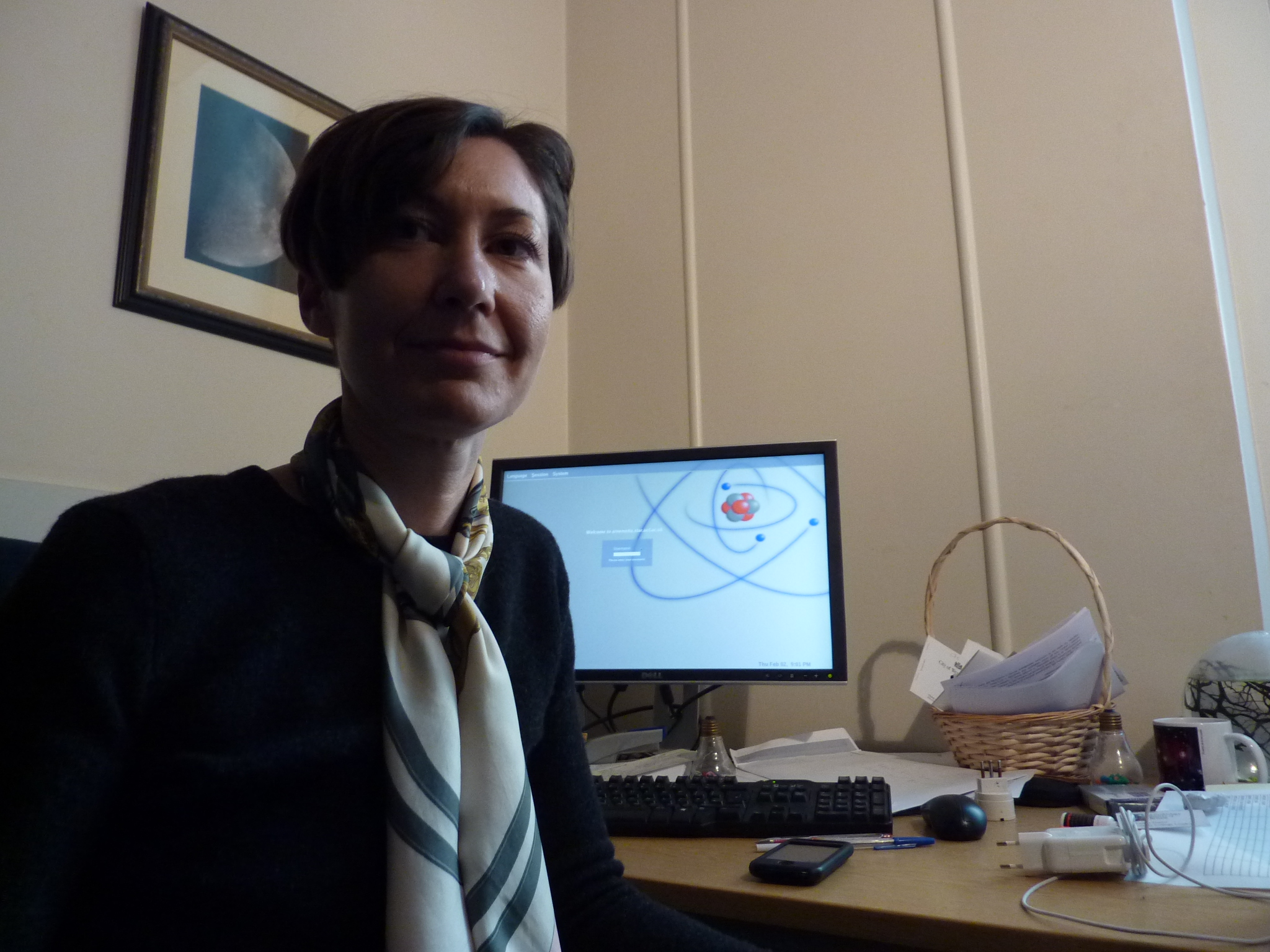
Giovanna Tinetti, Reader in Physics and Astronomy, University College London
And so all this work has been quite successful for planets which are a bit far away from the kind of habitable planet idea that clearly everybody’s interested in. But these techniques are improving and the idea is that we want to increase this kind of measurements of planets which are much more similar to our own Earth and the fact that a mission like Kepler which are providing us with a flood of new planets and new statistics is exactly what we need to do the next step and characterise these objects.
AS: So Kepler is sent off to find these faraway planets, but Giovanna and co are tasked with characterising them. They do this by looking at the molecules that make up the planets’ atmospheres.
GT: These planets are located very far away from us, so when I say neighbourhood usually we’re talking about several tens of light years away, so clearly we can’t go there and do the kind of in situ measurements like we do for planets in our own solar system. That would be great but it’s impossible, so the only way we can characterise these faraway objects is to look at the light that is coming to us and play a bit of tricks.
So basically we are looking at planets that usually have an orbit for which at a certain point the planet can pass in front of the star, and this technique is the same used by Kepler to find new ones, but what we want to do more with respect to Kepler is to look at this light at different wavelengths and in particular we want to look at the light in infrared and looking at this light, how this light is behaving in a different way as a functional wavelength… we can understand what kind of molecules are present in the atmospheres of these faraway planets.
AS: This process is known as spectroscopy, which is where Professor Jonathan Tennyson steps in. He’s the expert, so I’ll let him explain how you can use it to learn about exoplanets.
Jonathan Tennyson: Spectroscopy is basically a quantum mechanical phenomenon. So atoms and molecules have discrete energy levels and they can absorb light so they jump from one level to another, that gives every molecule a characteristic fingerprint, a bit like a bar code if you like to think of it.
And it’s why we can actually know more about, say, what stars the other side of the universe are made of than what the centre of the Earth is made of, because we get the light from the stars and we look at it very detailed according to its colour and we can identify what it’s made up of, what its atoms and its molecules are.
Now the issue that I’ve been dealing with is that a lot of these exoplanets we’ve been looking at are very hot, and that means the molecules in them are very hot, and that makes a spectra very complicated and difficult to model with laboratory spectra taken at normal laboratory room temperature. So to give you an example, I’ve worried a lot about water.
Water is very well studied because, as you may have noticed, there’s a lot of it in our own atmosphere, so for modelling, say climate change, in the Earth’s atmosphere, we have a database that everyone uses. It has about a hundred thousand waterlines in it (individual transitions, colours, where the water absorbs light). We have done a calculation for every hot water and that has 500 million transitions in it. And we can check that against what’s been done in the lab on Earth but no one wants to measure 500 million transitions because they would still be doing it some time centuries in the future.
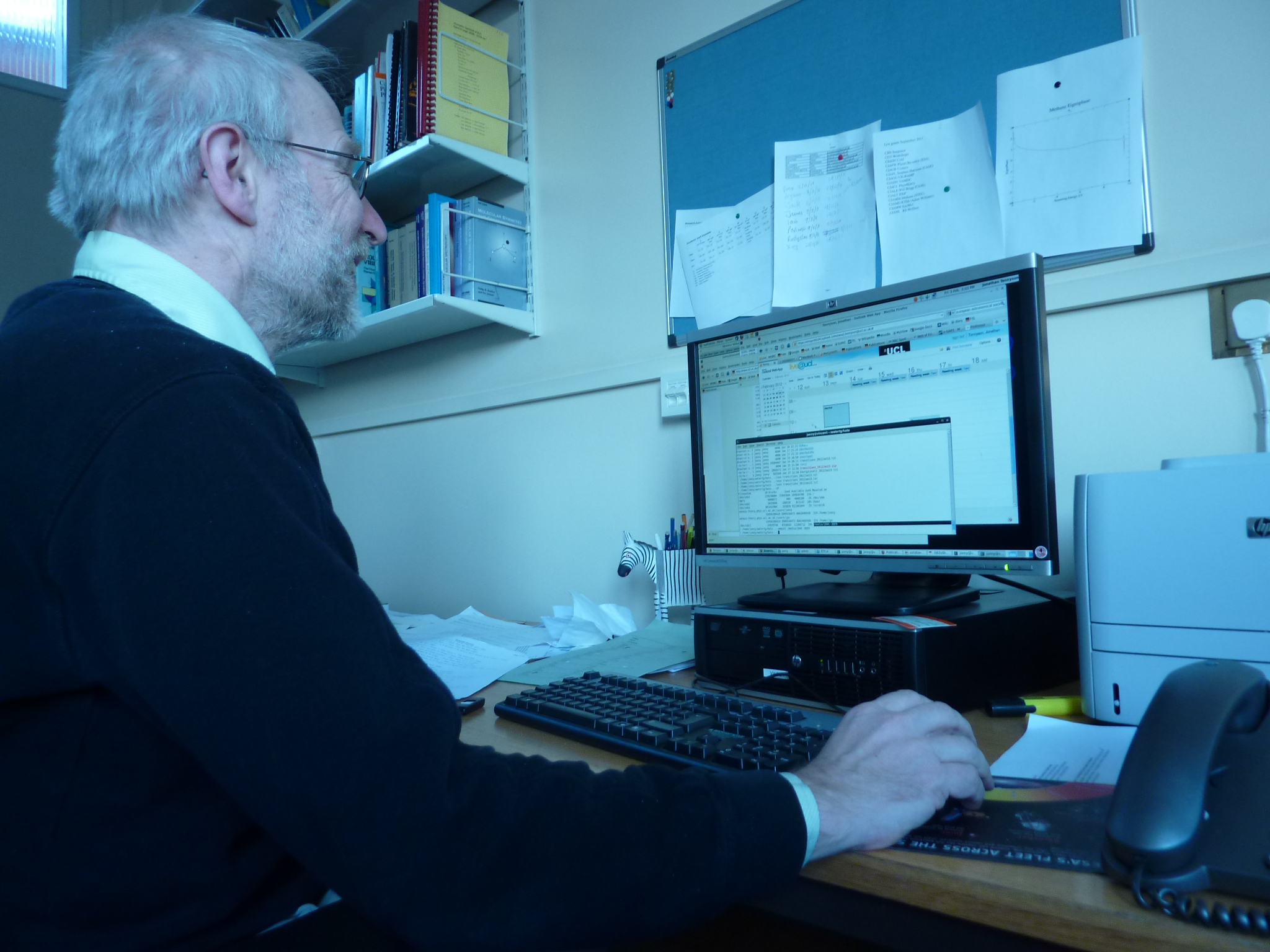
Jonathan Tennyson, Massey, Professor of Physics and Fellow of The Royal Society, University College London
AS: How does that apply to space and EP research specifically, looking at water that you’ve got on the planet Earth and looking far into the stars?
JT: We’ve passed in a sense the so-called ‘era of discovery’ in exoplanets. The first exoplanet was discovered sometime in the 1990s and people have been getting more and more of them. And within the past year I think it’s become accepted that virtually every star has planets orbiting around it. So we know they’re there and now we want to know what they’re made of. And, of course, eventually, is anyone living on any of them.
So what we want to do is characterise them and spectroscopy is the main tool for characterising them. You need to look at the light very carefully to make out what the main planet is made of – or in particular what the atmosphere is made of. It’s very difficult at the moment if you have a solid planet to work out what the surface is made of. This is not easy at all because the planet goes round a star, the star is very bright, you essentially can’t see the planet, so how do you see something which is essentially invisible against a very bright background? This is something Giovanna Tinetti, who I believe you’ve already heard from, really pioneered, was using the idea that certain planets transit in front of their star as you look at them from Earth.
So by looking at these planets which transit in front of their star you can look at the amount of light they get from the star before it transits, as it transits and then as the planet goes behind the star. And if you do this and you break the light up into different colours, you get a very elementary spectrum. Well, at the moment, they’re very elementary. We’re hoping that over time we’ll be able to make them more, much higher resolution, see the colours much more clearly. But that has already allowed us to characterise some molecular species in the atmospheres of these planets.
AS: The team use various telescopes dotted around the world to make new observations of the atmospheres, but at these distances it’s very difficult to be precise. Imagine standing at one end of a football pitch and trying to study a pea held by your friend at the other end – you can’t touch it or hold it – you can barely see it! By looking at the light bounced off the pea, spectroscopy can deliver buckets of data, but what do the planet hunters do with it all? They hand it to a PhD student, of course. Here’s Ingo Waldmann, who’s just finishing his Ph.D on Giovanna’s team.
Ingo Waldmann: I’m essentially a statisician and I look at something very boring: the noise in an instrument, to actually analyse the data. So yeah statistics is my thing and people should be more excited about it, but I understand why people don’t really care.
AS: Ingo reduces and analyses the data to produce an exoplanetary spectrum, which Giovanna then analyses. Tell us a little bit about this exoplanetary spectrum. What is it, what does it look like, what do you do with all the numbers?
IW: It’s just a few wiggly lines really. Essentially what it shows is that the radius of the planets seem to be larger or smaller for different wavelengths, which is due to the some of the light going through the atmosphere of those exoplanets when it is transiting its host star. And some of those molecules will absorb and emit at certain wavelengths, so it appears as if you have a bigger radius, so those are those wiggly lines, that’s the spectrum and looking at different wavelengths we can probe for different molecules, such as water or methane or CO2.
AS: There is one reward for wading through all this data – he gets to visit the telescopes that collect it.
IW: They’re all over the place – we need to have some quite big beasts for this sort of work. The smallest class of telescope we can usually go for is three, three and a half metres. So we usually go for the biggest ones, the eight metre class. In Chile, for example, the Very Large Telescope, VLT, but also in La Palma on the Canary Islands, in Hawaii, wherever we have eight metre size telescopes. And usually we choose the biggest ones.
AS: Did you chose this field so you go to far away, exciting places?
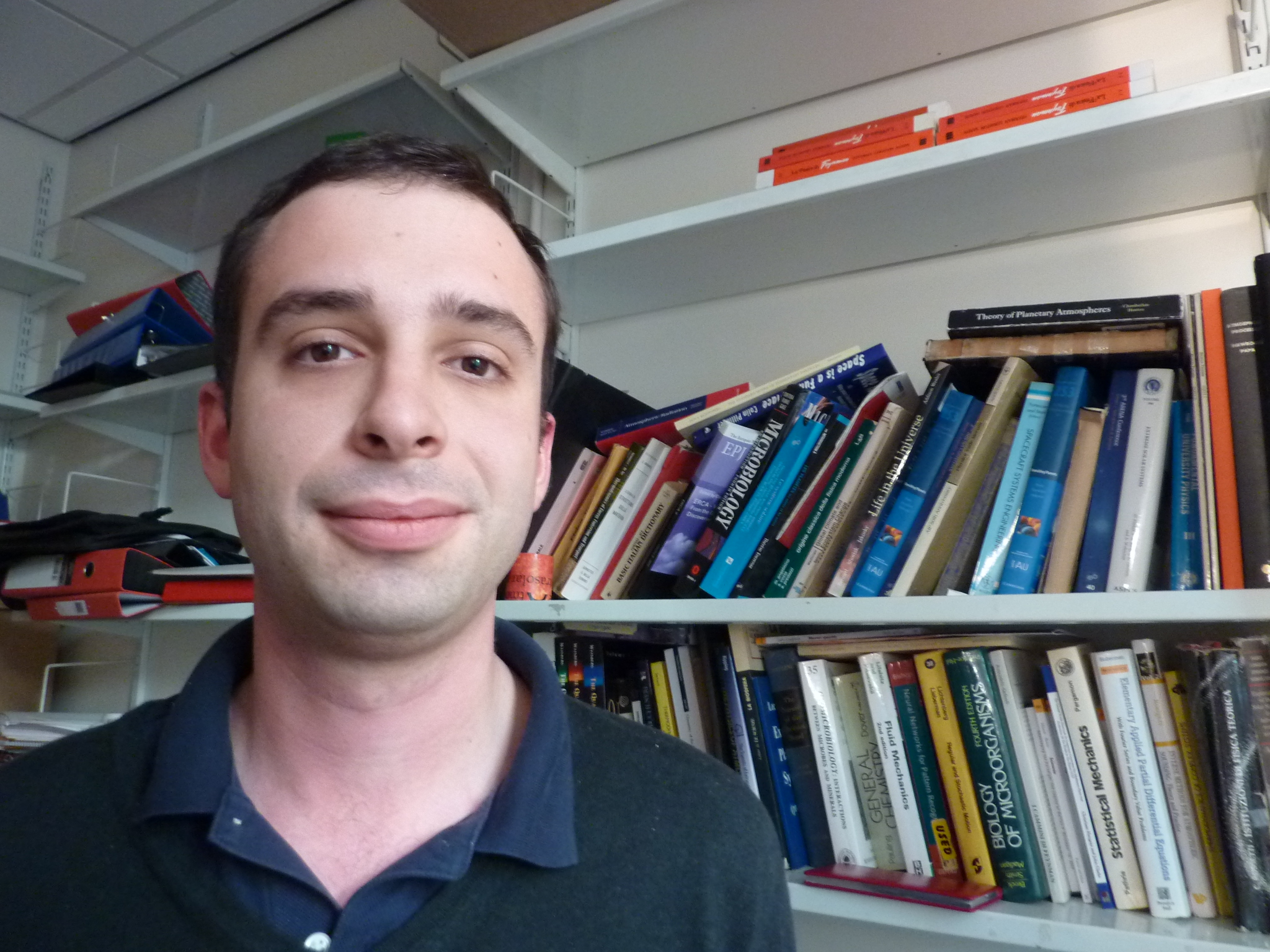
Ingo Waldmann, University College London
IW: Yes, entirely and utterly. It was in my first year undergrad when I had to decide between quantum physics and astrophysics, and I spoke to my tutor and my tutor told me to do astrophysics just because I get to play with the bigger tools. It was a 30-second decision that changed my life. And I quite like it. I get to go to cool places on European taxpayer’s money essentially.
AS: Let’s talk a little bit about your experiences of the VLT in Chile. What’s it like to go there?
IW: It’s fantastic, absolutely fantastic. Everything is catered for. You go down to Santiago and then you’re being flown up to the Atacama Desert, which is the driest place on our planet. It’s quite close to the sea actually, to the Pacific, it’s only twenty, thirty miles inwards that you have the driest conditions imaginable. But it’s fantastic, absolutely fantastic. There is no microbial life at all. In fact, all we have there are engineers and astronomers. That’s as good as it gets.
AS: Why is it important to have these telescopes in these particular locations?
IW: Well, it’s important because a low air humidity allows you to look at certain wavelengths that you can’t usually do that for. It’s important to go as high up and as dry as possible so you have the maximum transmissivity throughout the atmosphere.
AS: What do they do at the VLT in Chile to make sure that you and your colleagues can actually stay there and live there and do your work?
IW: Oh it’s actually quite fantastic. They build themselves a small palace, the VLT Guesthouse. Have you seen Quantum of Solace? It’s the one that blows up at the end. That’s the VLT Guesthouse. To combat the air humidity issue, what they’ve basically done is build two artificial oasises [sic] inside the building including swimming pools, sauna and all this sort of stuff. Palm trees inside the building – it’s amazing.
AS: So now we have this image of astronomers sitting there under palm trees next to the pool.
IW: Yes, essentially that’s it. But they have to feature quite a lot of amenities there because there is essentially nothing outside. And you can’t really go outside for too long. If you go outside for thirty, forty minutes you feel your skin drying up. And a lot of people who stay there for two weeks or so have bleeding palms. So you can’t have anything outside, you have to have everything inside. But it’s nice.
AS: But the problem with all the telescopes launched to date – whether VLT or Kepler or even the dear-old Hubble – is that none of them were built with the work of Giovanna and Jonathan in mind. That’s very inconvenient, and it’s why they need statisticians like Ingo to find ways through the data.
JT: You’re limited very much by the quality of the instrumentation one uses and so far this is largely been done by space.. and the space instrumentation was used because it was there, not because it was designed to do this. And of course you can better instrumentation from Earth but if you want to look at another Earth you can’t do it looking through our own atmosphere because all you see is our own atmosphere. Some of the exoplanetary spectra have been taken using the Hubble Space Telescope, which we all know is a very powerful but very generic telescope.
You have to look at the passes of the planets at different wavelengths at different times. You can’t stare for a long time because Hubble’s not designed that way. It’s not got the perfect wavelength coverage. It’s very good at the visible wavelength we see with our own eyes, it’s not so good with the heat-bearing wavelength of infrared where molecules have their characteristic signatures, so it’s there and we use it but it’s not perfect for the job.
AS: So the scientists are working on the next generation of space telescope, and are planning a rather special mission known as EChO.
JT: EChO is a multi-national, multi-European bid to launch a spacecraft. It’s Exoplanet Characterisation Observatory is what it’s called. What it does is what it says – you can use it to get a lot of information about extra solar planets and the main aim of EChO is that it should stare for a long time at individual planets and catch all the light at the same time. One of the problems if you use this transit technique is that you’re relying on the star itself being stable, so if you want to look at lots of different colours you have to look at each of them at a different time, but the star changes in the meantime you’re in a mess. So the idea of EChO is that it will look at all the colours at the same time, over a wide range of them, and you can really get a snapshot of that planet and what’s going on.
AS: And the person who’s leading the EChO project? Giovanna Tinetti…
GT: We really want to be able to observe several exoplanets and we want to be able to observe several planets that are quite gaseous and very massive but also so objects which are relatively small and also much colder and similar to our own Earth. We want to be able to look at planets orbiting different types of stars, colder than the Sun, hotter than the Sun. Through all these statistics of planets, comparing what they’re made of, why they are what they are, try to really start to classify these new planets and really be able to understand the process of formation and evolution of different planets around different types of stars and through that, understand our own solar system – if we are unique, rare, or just very common out there. We just don’t know yet.
AS: This is really exciting stuff – an entire space mission dedicated to understanding faraway planets. It’s basically Star Trek, only from a lab in central London rather than a starship in space. Here’s Giovanna on the mission status.
GT: We are at the moment of what is called phase zero – that’s how the European Space Agency is calling it, which means that we have already been selected out of about 60 other proposals and now a lot of effort is being put by the European Space Agency or some other countries and scientists in order to understand how best that we can plan this mission. And then at the end of 2013 we will know if we are the winner among the three other competitors and if we are the winner I guess it’s just a matter of really building the instrument, so we’re talking about 10 years away to the launch.
AS: So you have to wait almost a full two years to find out whether you’ve won to find out whether it will go ahead, and then perhaps a decade in total before we actually see anything. You’re playing the long game here, aren’t you?
GT: But this is the game of space missions in general. You can’t really build a space mission in less than 10 years. I know that for the common perception it looks like an insanely long amount of time, but from going from the phase where the mission is planned to the phase where industry are really finishing it and we’re ready to launch, 10 years is actually a snapshot, I can tell you… It’s like that for any other space mission. The downside, I guess, is that you really need to be able to see through time and making sure that your mission is very interesting and exciting in 10 years’ time. This is the challenge that all space missions have.
AS: The technology is changing so much in that time, presumably, so how do you make sure that the mission keeps pace with the technological change so that you don’t keep having to go back to the drawing board all the time?
GT: Well clearly you can’t keep going back to the drawing board, you need to freeze your space mission through steps which are mandatory steps and this has been done for other missions in the past. I would say that the kind of technique that EChO will use, it’s something very solid.
The technique of looking at transits is not something we have invented on the paper right now and we don’t know if it’s successful or not. Kepler is providing fantastic results using the kind of technique we will use, it’s just repeating the same measurement at different wavelengths. And we have already been doing this kind of exercise with Hubble and Spitzer, on the ground. So all sorts of reasons they’re doing very well but clearly not at the level we would need for going to the accuracy needed to look at more habitable kind of environment, we need an extra bit and the extra bit is: build an entire instrument to give you this stability you need and the perfect matching of all the instrument, and it gives you the extra quality needed.
AS: We might need to wait 10 years until we see EChO go up – that’s IF it gets the green light from the European Space Agency. A decade is a long time for the public to sustain its interest in the search for exoplanets, which, as Giovanna notes, is on the rise…
GT: The interest in extra solar planets has really increased exponentially as much as the number of exoplanets discovered. I would imagine it’s because it’s a very new field.
The first exoplanet, a planet around another star, was discovered in 1995. So it’s literally a very little time ago. Before 1995 people were clearly predicting exoplanets, but one thing is you have the theory, another thing you the experiment and another thing you have is an experiment that’s successful. When I started to work in this field, very few planets were detected and discovered and it seems like a bit like a bet: it could go very well or very wrong. It’s quite amazing that now we’re touching almost one thousand new planets since 1995, so it gives you the breadth and novelty of this field. It’s very exciting for a scientist but I would imagine for everybody understanding that you have all these alien worlds out there and I would imagine everyone has the curiosity to understand what they’re made of and what kind of planets and environment we can think of. That, maybe, is the excitement.
AS: Do you think that we will find life elsewhere in the universe?
JT: I am personally pretty convinced that there is life elsewhere in the universe. I hope to live to see it found. You can never predict the future on these things. But I think it would be very exciting if we could find it. I think the sort of life we’re likely to find is not the sort doing radio interviews. It’s going to be amoebas or maybe primitive dinosaur-type lifeforms and we’ll see it from various signatures that the effect of having life on a planet has on their atmosphere. I don’t think I will live to see any sort of communication with any other sort of life.
AS: What is it that convinces you that we will find life, though?
JT: Simply the statistics. There are a huge number of planets out there and I would be very surprised that our one is so unique that even if there are special conditions that have created life on Earth a number of very accidental things have allowed us to flourish here. There are just so many planets out there that I would be really astounded if we were the only planet that these conditions had occurred on.
AS: Well, you heard the man. The cleaning sprays and dishcloths are almost certainly there at the back of the cupboard – it’s just up to folks like Giovanna, Jonathan and Ingo to reach as far as they can into the dark to find them. We can be even more sure that the inhabitants of any exoplanet have a better way of organising their kitchen cupboards.
If you enjoyed this podcast, remember you can read the transcript, click on the related resources and hear more podcasts from the science and environment faculty at podacademy.org.
Presented and produced for Pod Academy by Adam Smith.
Notes
- Kepler mission
- Department of Physics & Astronomy at University College London
- Spitzer Space Telescope
- Hubble Space Telescope
- About spectroscopy
- Exoplanet Orbit Database
- The Exoplanet Characterisation Observatorymission (EcHO)
- Extrasolar Planets Encyclopedia
- BBC Universe – Extrasolar Planets
- Giovanna Tinetti
- Jonathan Tennyson
Tags: Astronomy, European Space Agency, Exoplanet Characterisation Observatory, Giovanna Tinetti, Hubble Space Telescope, Jonathan Tennyson, Kepler, NASA, Physics, Spectroscopy, University College London, VLT Guesthouse
Amazing – only this week I was having a similar discussion about planets and we both quickly realised we had a serious lack of knowledge… Perfect timing 🙂
The only thing is that the Kepler 22b exoplanet is – I believe – around 600 light years away. Really way beyond our ability to travel there any time soon, given our current state of technology. We’ll just have to make sure we don’t mess up our own planet for a long long long time to come !!
Pingback: Jonathan Tennyson – molecules on other planets | JPhys+