


Transcript
In the last ten years the humanities has become obsessed with stuff – things, ephemera, paraphernalia and possessions. Writer and critic Brian Dillon speaks to Steven Connor, Professor of Modern Literature and Theory at Birkbeck College, London, about the curious magic of everyday things.
Brian Dillon: It seems as if, in recent years, and after a couple of decades of academia in general and the humanities in particular being concerned with language – with structures of meaning, whether verbal or based on ideas taken from linguistics, such as reading images through linguistics, all of this going under the broad name of semiotics and structuralism and so on – it seems that after some decades of that the humanities now seem to be obsessed with things, by objects, by something that has become known as ‘thing studies’ [sometimes thing theory, material culture or object studies]. We find this with scholars like Sherry Turkle, who writes on the meaning of contemporary technology, or even popular successors like Neil MacGregor’s A History of the World in 100 Objects, the book based around the British Museum collection. Things seem to be in the air.
Seven Connor: Yes, and I think that’s partly just because we got tired. Ideas just grow old, no matter how true they are, how compelling they are, they just lose their force, we start to get interested in other things. Thank goodness! In my case I’ve become interested … well, I haven’t become interested in things; I’ve just become impatient with pretending that I’m not. It’s not that I’ve become uninterested in all the things that I was schooled to be interested in –signs, codes, information, the ways in which things are also signs and symbols – but there has always seemed so much more that lacked a language. I’ve been interested over quite a long period of time in trying to get out from under that, at perhaps to step aside from that accepted perspective, not because it’s wrong, not because it’s mistaken but just because it’s not complete. I don’t know whether you feel the same thing is involved in other people that are interested in writing about things? Is there some sort of nostalgia or some kind of ‘coming home’ to the way that ‘things’ are?
BD: I think there’s a definite strain of nostalgia that you see, for example, in a recent literary success like Edmund de Waal’s book, The Hare With Amber Eyes: A Hidden Inheritance, about a collection of nitsuke, these exquisite and tiny wood, porcelain and jade figures that were inherited through his family. One of the things this book is about is a voyage of rediscovery of the materiality of those objects; they go on a long journey throughout the history of the twentieth century. They are lost during the Second World War, they are regained and they end up in the author’s possession. The book is very much about handling, it’s about that meticulous, material fondling and living with these objects on a day-to-day basis. Brilliant as that kind of narrative is, and you also find it in some of the writings of the late W. G. Sebald – “things know more about us than we do about them” or narratives written from the perspective of the object, he seems to be on the side of the object, there always seems to be a kind of lugubrious mourning for that physical experience. It seems as if what you’re doing in the book, Paraphernalia, is a related but very different project. Although you write very brilliantly about the experience of certain objects as a child your book is not nostalgic, it’s not engaged in the notion of the object as a repository of memory, or not straightforwardly as a repository of memory. Would that be right?
SC: I think sometimes objects are there for their antiquity, for this mysterious connection to some lost past, it’s that melancholy tinge that you often find in the writing of Walter Benjamin, for example, who writes a lot about the importance of objects but always, I think, with this melancholy cast. The object is always lost or is an image of something we’ve lost. And you know, we haven’t lost objects because we’re surrounded by them and we carry them around with us all the time. It’s that we carry things around with us that was one of my ways into this book. I suddenly thought: we just carry so much stuff around for god’s sake. One of the reasons we wear clothes is in order that we may carry more things around. We’re all of us kind of shoplifters, in a way; that’s what the history of human attire is, at least for the history of male attire. So, it’s the ever-present reality of things.
Now, this word: ‘materiality’. It’s often used by academics for understandable reasons. But there’s something so extraordinarily abstract and unmaterial about ideas of materiality. If you ask people to inspect their ideas of what ‘material’ means then they’ll probably think of something hard, they’ll probably have a ‘Dr. Johnson moment’ and think, ‘yes, it’s the stone that I kick and thereby refute abstraction and fantasy.’ But of course materiality is not of one kind; there isn’t one way for a thing to be material. One of the things I love about the material world – and I tell you it’s love – is that there’s really only one way I can be me but there’s millions of ways that the so-called material world can be not me. That’s a source of inexhaustability – inexhaustible frustration, sometimes – but the sheer multiplicity of the ways in which things are, suggest that there’s a whole lifetime of stuff to be investigated. This isn’t a principle of redemption it’s just interesting. And you know what? It’s what humans do. It’s our speciality: things.
BD: The book is extremely eloquent about objects it’s also very aware of the long history of eloquence about things. I wonder if there is a problem or question here to do with the kind of language that does justice to things? One of the passages that I’m teaching at the moment is a section very early on in Madame Bovary, where Flaubert describes Charles Bovary’s hat. This hat is not simply a schoolboy’s hat that denotes his lowly place in the world, his potential aspirations to bourgeois life, and so on. Although it does all those things it is also an extraordinarily complicated meaning machine full of levels, it’s stratified, it’s like a cake. In fact, it’s compared later on in the novel to the wedding cake of Charles and Emma Bovary. I’m wondering if Flaubert’s technique here is to layer the object and describe layer by layer. Is that kind of meticulous care towards description something that interests you?
SC: Yes, I think that when you’re writing about objects – although it’s not something I’ve ever seriously done until now, though if you are an art historian it is something you have to learn to do early on. The writing about an object can highlight the ‘objectness’ of one’s own writing. Now there’s a way in which that gets really, really self-reflexive and wound up in itself and I think one of the most liberating things about writing about objects is that you stop thinking about the writing. You start thinking about the object. You start thinking, ‘no, that’s not quite right for the sound of Sellotape. Does it rip, no it sort of rasps but it does a sort of shriek.’ So you have to do justice to the object and you stop thinking about the writing – which is always a good thing to do, though it’s not often done. The pleasure of writing, for me and I suspect for a lot of other people who are interested in writing about objects (a bizarre thing to do, since writing is dematerialising, writing is not the thing itself but a deliberate divergence from the thing itself), is an ability to yield to you that strong sculptural sense of working with words. For me this is just sheer joy, it’s the thing I enjoy more than anything else, the thing I secretly want to do all the time. I don’t think this is very special. Anyone who enjoys telling jokes has exactly the same poetic pleasure in springing the machinery just right. Or anyone who does voices – all those adolescent social forms that brings out that poesis of language, that thingy-ness, that moving across language as such that we get that tinkerer’s relationship with the word. Do you feel like that? You write a lot more about art historical objects…
BD: I write a great deal about photography more than painting and sculpture. But, having done this for about a decade, the thing I realised is that writing about photographs was an excuse for writing about things. Or for writing about surfaces or for stray details of photographs. There’s a long tradition of writing about stray details in photographs – Roland Barthes in his great book Camera Lucida (1980) is a prime example of this in the history photographic criticism. One of the striking things about the process of writing about an object is that moment where, as you say, lose yourself in the object. What gets left behind there, gets usefully left behind, is the psychologising attitude to objects that might have been one way for you to have thought about things in this book. Not just ‘psychologising’ but, more precisely, psychoanalytic. It seems to me as if psychoanalysis would be one absolutely prominent way of thinking about our daily relationship with objects. Freud brilliantly describes the ways in which objects betray us. They betray our secret desires and meanings and intentions; we trip over things, we lose our keys and, not only that but our servants, in the Psychopathology of Everyday Life (1901), are apt to come into the room and knock over items of furniture or ornaments and so on. So we are beset by objects in Freud’s world. But it seems the kind of approach that for you and, I think, for some others, is much more useful and productive and more poetic, is one that shies away from those depths. It wants to stay much more on the level of a daily, quotidian, ordinary, praxis, because that’s actually what turns out to be already full of profundity.
SC: Yes, although there are quite a lot of people in the academic world and elsewhere celebrating the ordinary or the everyday as though there were secret, undiscovered riches there. I don’t really feel that. I read a lot like you do so our everyday lives are full of the most extraordinary, esoteric things! Part of my everyday life is spent reflecting upon philosophical and theological concepts that are just the opposite of the everyday, but they’re ‘everyday’ for me. I don’t think that’s unusual. That said, we’ve been encouraged to feel that so much of our lives have not been accounted for. So there is a great terrain of things that we might have something to say about that we don’t usually give ourselves permission to talk about. Instead we talk about much more abstract things like ‘commodities’ or whether things are bought and sold. I can’t find an interesting way of saying how uninteresting I find that idea. What matters is what it is.
BD: This seems to open up a field. like ‘things’ or ‘objects’, that is culturally in the air at the moment: a renewed idea of curiosity. Something like the British Museum’s 100 Objects programme and the book, suggests that there is an appetite for specificities that we might otherwise have ignored. Whether they are in fact, as in the case of Neil MacGreggor’s project, specific things or, in yours, generic things that have been out of the way. It turns out, very often, that those are precisely the objects that allow us to bring those great abstractions into some kind of relationship with one another, almost as if the object functions as a nexus through which different disciplines – history, archaeology, theology, futurology, music, writing, etc – can come together. It might be that ‘thing studies’ is a name for a kind of impatience among many academics with the limitations of their disciplines. Somehow the much more precise and intimate focus allows for a view of the big intellectual picture. Something called ‘curiosity’ in the sense that it might have obtained in the seventeenth century with the cabinet of curiosities. These were spaces that were a precursor to the modern museum in which objects from all sorts of backgrounds, whether natural or man made, come together.
SC: That’s certainly part of the impulse, an impulse to cultivate a kind of naivety. I think that might be at the heart of it. It’s a sort of impatience with knowingness, that there might be something to be gained from impulses and feelings like those of curiosity and wonder – the passion celebrated by Descartes in his Passions of the Soul (1649). But I think we have to be careful, too. I don’t really like the big talk that suggests this is all about seeing a universe in a grain of sand or that talking about objects or about everyday life, oblique things, or unexpected things, is the key which has previously eluded us, that we can get to the big things through the small things, that it’s somehow a way of understanding the unconscious. I just think it’s something we can do that we haven’t done and it’s actually not everything. I think that our culture is one, and certainly academic culture is like this, in which we want to hurry to conclusions, outcomes and significances. Why are we doing this? ‘Well, we’re doing this … because!’ Well sometimes you just don’t know and usually you don’t know – it turns out you’re doing something for a complete different reason. To enlarge the scope of possibilities doesn’t mean you have to do that forever but to enlarge the scope of possibilities certainly cheers people up a bit. And we could do with that. It certainly cheers me up to feel that there are other things that could be done or thought about seriously and sustainedly. It might not do everything for us, it might not give us political redemption and it might not bring capitalism down and inaugurate a realm of equality, justice and universal emancipation. But, then, who seriously thinks that it might?
BD: Well in the book you’re not dealing with the individual object as a repository of narrative and history, be it collective, familial or individual. You talk about wanting to deal with generic objects. The most ordinary objects that one can find and we can talk about some precise examples of those in a moment. That idea of the absolute ordinariness of the object seems absolutely crucial to this new, somewhat adjacent way of thinking of and thinking about the object per se.
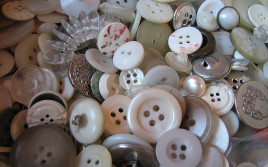
SC: Well it certainly is for me and it is I think for some others, although there are lots of different ways you can write about things. Sometimes people are interested in very, very special and unique objects but it became clear to me that the things that I’m interested in are things like rubber bands or paperclips or buttons – there’s something about the collective about them, the fact that we’ve known lots and lots of these objects, something that we grasp as a kind of complex, rather fuzzy totality. That’s very much part of an existence in mass production – there are lots and lots of things of which we get many, many semi-identical examples but I think that was true even before mass production. A stick was one example of all the many ways in which you could make and acquire a stick. I don’t really know what I think about that but there’s something about that radiation of possibilities that is for me is the interesting thing about everyday objects. They are as they are but they don’t have to be as they are, there could be variations. The technical term is ‘affordance’. There are some things that say this is what you do with me: you look at rifle or a pikestaff and you think, well it’s obvious what you do that; you point it and shoot it or you point it and pierce somebody with it. But there are other kinds of objects – like a paperclip – where it’s obvious what you do with it – kind of. But that’s not what you want to do with it; we want to see how far it spreads out beyond itself.
BD: I think that’s probably what paperclips are for…
SC: Yes, they are for experimental play with possibility.
BD: One of the fantasies that attaches to my personal use of objects, because I carry my objects around in a bag and I know from reading your book that you carry a lot of stuff in your pockets, and that seems very alien to me, one of the fantasies that attaches to the bag is that I actually have my entire office and, therefore, because I think of myself as a writer, my entire life with me. That sense of the portability of one’s thought is actually bound up in the object.
SC: I spend a lot of time with these things – this is my bunch of keys. Which, in the way of such things, gets bigger and hardly smaller, and there are few keys on there that I couldn’t tell you what they’re for. This one is nestling in my hand at the moment and the jingle that it makes is the important part of the reassurance that it has for me. I couldn’t imagine being a creature that didn’t know where their keys were on their person at all times. This is an uncomfortable thing, I’m squeezing it now and it’s uncomfortable, it’s got lots of knobs. But that’s what is wonderful, in my right-hand pocket, that’s where it always is (pickpockets take note!). If it isn’t there then there is this terrible gulf or chasm in my being that I’m not quite aware of but sooner or later I become aware of it.
BD: A key always has other kinds of potential. It’s one of the things that you say very early on in your book – the more ordinary the object, the more uses it seems to suggest. I think at one stage you also say that the key, stereotypically, is cold and that automatically chimed with me because I have a very vivid memory as a child that every time I banged my head one of two things would come out. Because we didn’t have an icebox when I was very young, there was no ice to put on a contusion on my forehead, so it was either a coin or if there wasn’t a coin to hand then it was a key. A key was the cold thing, probably the coldest thing in the room at any one moment. So, my thought was then: where had the key come from? If it was my father’s pocket then it probably wasn’t cold so there must have been a place where the keys lived. So keys are not only things that go in locks, they have other kinds of uses.
SC: That’s true and my keys, as I say, are almost always about my person. They have a rather interesting smell, people don’t usually talk about the smell of metal but it’s very extraordinary. And cold keys are very wonderful. I know them from nosebleeds; people putting the key on the back of the neck or down my neck. It never worked but it was so absorbing as an operation that you didn’t worry about the nosebleed or, in your case, the bump. So in this case I think there is with keys, but also with pens and pencils and so on, a special sort of magic. A ‘what if this thing has some hidden remedial and creative powers, that it didn’t seem to have?’ And that’s very often the case, I think, with very ordinary objects that have been taken up in folklore. Things like rings and hats and shoes – especially items of clothing – items that we have about us that seem like they’re body-doubles for us.
I think that the idea of the object as an ‘extension of us’ and thereby, potentially, transforms or projects us into the inorganic world (spoken about with a mixture of exhilaration and concern) might have given way to a concern with the ways in which objects are simply not us. Of course we wrap ourselves around them and wrap them around us, in clothing and so forth, but I’m not an animist. Objects are not alive. And here’s a fundamental insight, it’s not my insight it’s the insight of a philosopher and historian of science called Michel Serres. Serres writes in his book Statues (1989) that the things we call ‘subjects’ or ‘conscious beings’ come into being not by being conscious of themselves, not in being, as it were, a sort of transparency to yourself, but they come into being by coming into contact with things called ‘objects’. There’s a moment at which a creature, a being, suddenly conceives of something that is not it. Babies have this moment when they encounter what D. W. Winnicott calls ‘transitional objects’ – blankets and other accompanying objects – that give reassurance. It’s important that the thing is not you. And arguably if you’re not a subject, if you’re not a conscious being, if you’re an animal say, you never have that notion of an object’s absolute ‘not-youness’. My cat employs objects for various purposes but those objects are thereby entirely subsumed within their use. So, curiously enough, to be a subject there has to be something that is absolutely beyond you, in certain respects. I think that’s a very important thing. It’s an important part of the wonderful, joyful abundance of all the many things that are not me in the world. Such deep reassurance. The world keeps me from myself. “The world is too much with us”, says Wordsworth, but he’s completely wrong. We’re too much with ourselves. So I think there’s something important in that engagement with the thing that is not you. It’s perhaps a much more traditional philosophical engagement with what is thought of as the ‘Other’ or the ‘Not-self’, which is something that comes up against you but is also a source of tremendous enlargement and possibility.
This podcast was recorded for Pod Academy by Ricky Russell and edited by Will Viney.
Notes
Brian Dillon
Brian Dillon is the editor of Cabinet Magazine
Selected Readings and Websites
Baudrillard, Jean. The System of Objects. Translated by James Benedict. London: Verso, 1996.
Brown, Bill. “Thing Theory.” Critical Inquiry 28, no. 1 (2001): 1–22.
Connor, Steven. Paraphernalia: The Curious Magic of Everyday Things. London: Profile, 2011.
Daston, Lorraine, Things that Talk: Object Lessons from Art and Science. Cambridge, MA: Zone, 2007.
Kopytoff, Igor. “The Cultural Biography of Things: Commoditization as Process.” In The Social Life of Things: Commodities in Cultural Perspective. Edited by Arjun Appadurai, 64–91. Cambridge: CUP, 1986.
Miller, Daniel. The Comfort of Things. Cambridge: Polity, 2008.
Olsen, Bjørnar. In Defense of Things: Archaeology and the Ontology of Objects. Lanham, ML: Rowman & Littlefield, 2010.
Sartre, Jean-Paul. Being and Nothingness: An Essay on Phenomenological Ontology. Translated by Hazel E. Barnes.1958; London: Routledge, 2000.
Schwenger, Peter. The Tears of Things: Melancholy and Physical Objects. Minnesota: Minnesota UP, 2005.
Turkle, Sherry (ed.). Evocative Objects: Things We Think With. Cambridge, MA: MIT, 2007.
Steven Connor’s website: www.stevenconnor.com
Brian Dillon’s blog: Ruins of the 20th Century
Graham Harman’s blog: Object-Orientated Philosophy
Material World: An interactive, online hub for contemporary debates, discussion, thinking and research centred on material and visual culture.
Tags: Brian Dillon, Descartes, Edmund de Waal, Freud, Generic, Madame Bovary, Michel Serres, Neil MacGregor, Objects, Paraphenalia, Philosophy, Psychopathology of Everyday Life, Roland Barthes, Sherry Turkle, Steven Connor, Stuff, Thing Studies, Things, W. G. Sebald
Why throw semiology out just because we have recently become interested in things? The notion that ‘ideas just get old’ is ridiculous. This is fashionable movement determined by the academic industry that always wants something new to write articles and have conferences about. Some interesting aspects but a tendency towards the trivial!
Interesting to hear Bruno Latour speak about his discovery of symmetrical anthropology – in which things and humans have the same ontological status – through his conversations with French semioticians: http://www.youtube.com/watch?v=gL3WBHTWDjI&feature=plcp
Rod, I think you’ve misunderstood the intention of this podcast. First, Brian Dillon talks in broad strokes about what he thinks has happened in the humanities (no adoption of the personal pronoun, not much sense of personal investment in this overview… I think he’s a great champion of Barthes, as it happens). Secondly, Steven Connor then says that he was schooled in semiology only to find that there are aspects of life that are unaccounted for in this system – of which ‘things’ might be one. That doesn’t seem to suggest a wholesale abandonment of the semiological project, either.
‘This is fashionable movement determined by the academic industry that always wants something new to write articles and have conferences about’ – I think skeptics said something similar in the 60s and 70s about semiology. I have no problem with academic modes and moods changing but I don’t think one trend necessarily supersedes another. Thing theory, as I understand it, and semiology are largely compatible – both have a great investment in narrative form.
PS. If ideas don’t get old, outlive the time of their making, or are proven wrong, then what sort of atemporal condition do they exist in?
That’s a reasonable reproach but, there’s no reason why the structural project (analysing underlying determinations) or semiology (understanding how meaning is made through signs) cannot take on the domain now claimed by Thing Theory. You are right about supercession although the academic industry has proliferated in the decades since 1970… I never suggested an atemporal space – no theory is outside of its history or History itself. I am sceptical whether (despite its self-described novelty) Thing Theory really goes beyond semiology.
Ibn-Arabi made a creative solution to the problem of universals by recasting it as a thing and its names. Perhaps we are catching up with him.
thanks for making all this material public.
http://syntheticzero.net/2014/04/06/a-philosophy-of-everyday-things-steven-connor/
I read this piece of writing completely about the difference of most up-to-date and previous technologies, it’s awesome article.