


Transcript
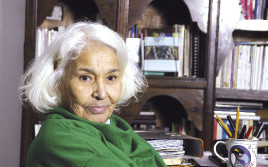
Tess Woodcraft writes: The death of writer and activist Nawal el Saadawi has just been announced. In 2012 I interviewed her at a conference organised by the Iranian and Kurdish Women’s Right Organisation for Pod Academy. Typically, and at 81 years old, she had stopped off at the Occupy encampment around St Paul’s Cathedral on her way from the airport, before coming on to the conference.
Note: there is also an Italian translation of this podcast, by Federica di Lascio, below.
Nawal el Saadawi is one of the foremost Egyptian writers. A doctor by profession, she has written over 40 books of fiction and non-fiction, which have been translated into 30 languages. Since her very first novel, written in her twenties, she has taken on some of the most difficult, challenging, controversial subjects, including: female genital mutilation, domestic violence, child marriage, prostitution, the impact of war on women and children, so-called ‘honour killing’ and the laws that maintain women’s status as minors.
It is not surprising perhaps that this has made her many powerful enemies. She has been forced out of employment, she was imprisoned by the Egyptian authorities in the 1980s and in the 1990s she lived under serious death threats from religious fundamentalists. Indeed, she was forced into exile. But now she is back in Egypt where, although now in her eighties, she took an active role in the demonstrations in Tahrir Square last Spring and continues to fight to ensure that women’s rights are part of the political settlement in Egypt. Her writing and activism are seen by women around the world as a beacon of light and she has received many awards, literary and academic.
This interview was recorded at a conference in London organised by IKWRO, the Iranian and Kurdish Women’s Rights Organisation, which works to end honour killing and sexual violence against women.
Tess Woodcraft: What did you mean when you wrote in your autobiography: ‘writing is my sole refuge, it’s like breathing’?
Nawal el Saadawi: My work is my love and when you love your work you can do it well. Since childhood I was forced to study medicine, to become a doctor. But I didn’t dream of being a physician – I dreamt of art, music, poetry, dancing, writing novels.
Of course there is no separation of creativity in science and art, but when I was a child I loved to move my body, to dance and this is natural. But in Egypt at that time it was a taboo to be a dancer or a film actress, and it was very respectable to be a doctor. So I accepted the advice of my parents and went into the medical profession. But all the time I felt that my writing was my life, and all the time I kept a secret diary under my pillow, and I have never stopped writing from then till now. It is more than oxygen, it is my life. It is more than breathing
TW: How do you see the relationship between your writing and your political activism?
N el S: They are inseparable. Writing and fighting are inseparable. Why do we write? Because it gives us pleasure. Creativity gives us pleasure. The pleasure of creativity is above everything – it can cure us of all our pains. But of course creativity can also lead to you to prison and to exile because you challenge the system. But the pleasure of creativity is more than the pain
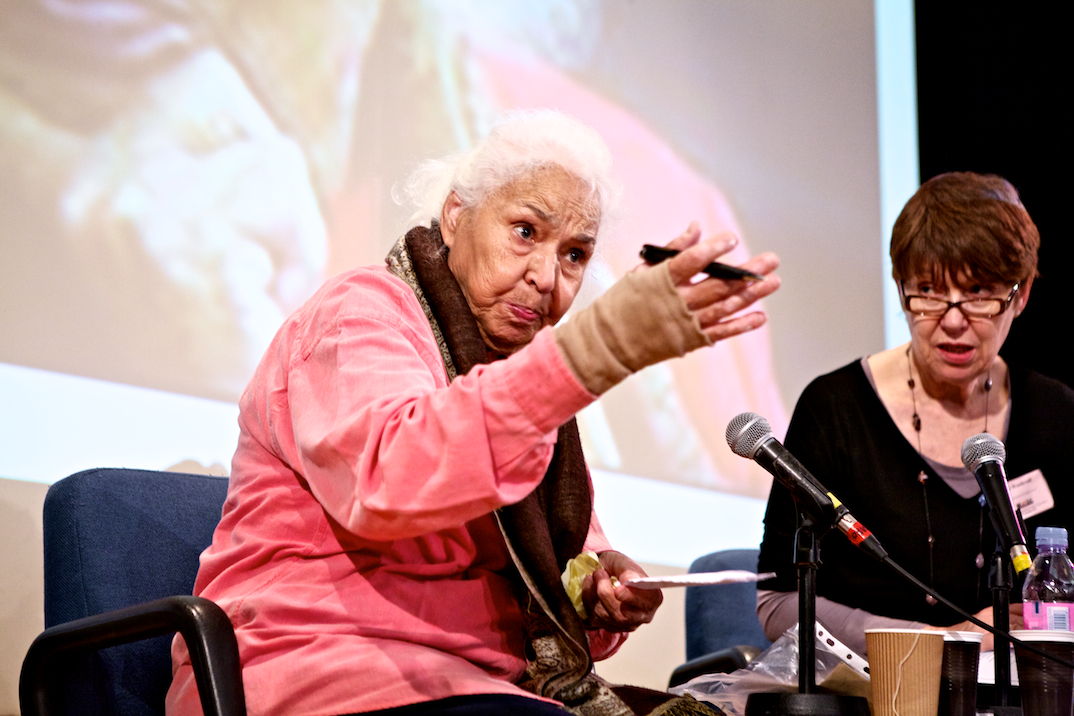
Nawal el Saadawi at the IKWRO conference
TW: You’ve tackled some of the most difficult issues, – one of these is female genital mutilation. Despite efforts to outlaw it, it is still practised in many countries. Is it possible to change this?
N el S: Of course, but there are many sexual problems in the lives of women – female genital mutilation, rape, honour killing, forced marriages. They are usually tackled separately, but we have to connect in order to cure. In order to cure the problem, we have to know why we have it. Why is the clitoris of women cut? (and we have to link male genital mutilation to female genital mutilation because it is cutting children). Why are children cut in this way?
We have to study history. These are ancient historical customs. They are political customs, economic customs, sexual customs – and they are all related.
If we can just understand the causes of any problem, then we can eradicate it. This is something we studied in medical school – you cannot cure anything (and that goes for Female Genital Mutilation (FGM), honour killing and so on) if we do not know the real reasons.
Honour. Whose honour are we talking about? It is the man’s honour. It is the name of the father that has the honour. In most countries, children who take the name of the mother are illegitimate. In order to be legitimate, to be legal, you must have a father. So ‘the name of the father’ is the reason for women’s sexual and political problems.
Patriarchy is based on the name of the father. In history, since the beginning, there was the feudal patriarchy, then the capitalist patriarchal system. We are still living under the capitalist patriarchal system today. In every country the name of the father has the honour. Indeed, the name of the mother is even considered dishonourable in Egypt. But I’ll tell you how we can change that. We are fighting to give the mother’s name some honour and to eradicate the concept of illegitimate children.
I think we should connect rape, honour killing and female genital mutilation to patriarchy and to class. And the name of the mother should be exactly as honourable as the name of the father. Patriarchal society is very afraid of the name of the mother becoming honourable because they want women to be monogamous. If it is easy for a girl to have sexual relations and carry a child outside of marriage, with the father’s identity being unknown, then this threatens the whole capitalist patriarchal system.
TW: Can you tell us what the situation in Egypt is now around honour killing? Is there still honour killing in Egypt?
N el S: Of course there is still honour killing in Egypt today. I can give you two stories that were horrible but significant. (But, despite this, I am also optimistic that we are going forward). We need to empower the mother because, as these two stories demonstrate, when the mother is weak, she may even help in killing her own daughter.
I live in Shoubra and the next district along is called Imbabe. It was there that there was a horrible honour killing. We saw in the street the mother cheering and walking in the streets. Next to her was her son who had killed her daughter; he was carrying the head of his own sister. He was carrying the head of his sister, showing the people that he had restored the honour of his family. And there was the mother of the girl, beside him, walking in the street and cheering because her daughter had been killed. So you see how the mother herself is a slave to the concept of patriarchy and how she can betray her daughter by leaving her to be killed. This woman was educated, which shows that education sometimes does not make any difference.
Another story from Northern Egypt shows an opposite situation. It is about a powerful mother who, though not educated, had dignity, common sense, intelligence and personality. She loved and protected her daughter who was raped by her paternal cousin and became pregnant. The father, the cousin who had raped her, his father and the uncles gathered together and said, this girl should be killed for the honour of the family. They said this even though they knew that it was the cousin that raped her. Because the honour of the family is above ethics, above conscience, above everything. These men planned to kill the girl, who was very young, only 16. But the mother said no. They decided to force the girl into having an abortion and then to kill her. They planned all this but the mother was aware and she went with them to the hospital and never left her daughter’s side. Whatever they said to her, she responded, ‘No, I am going to stay with my daughter until the end’. And in the end these men killed the mother and daughter together because they could not get rid of the mother. Of course, the mother failed in spite of her power but we need to train and educate mothers so that they can have dignity and understand justice and patriarchy. We need to empower women with education and economic independence so they are not so weak that they submit to the concept of killing their daughters and can help save them instead.
TW: That brings us very naturally to the situation in Egypt now. You took an active part in the demonstrations in Tahrir Square – and here at St Paul’s. You said that you had been waiting your whole life for the revolution.
N el S: I have been dreaming since I was a child that there would be a revolution in Egypt, but also worldwide, that would cause the whole world to change. So when the Tahrir Square revolution came, I found myself there, as if I was living my dream. I was staying under the tent with the men and women there in Tahrir Square as if it was a dream. For seventy years I have been dreaming of this revolution.
TW: Watching it on television here, there seemed to be many women involved in Tahrir Square and yet you have said women must move very fast if they are to secure their rights in Egypt.
N el S: My fear is of a counter-revolution. In every revolution in history, for example the British, French and American Revolutions, there has always been a counter-revolution.
TW: So do you think women’s rights are a divisive issue in Egypt?
N el S: No. We started the Egyptian Women’s Movement, the Egyptian women’s Union. While we were in Tahrir square, we feared that we would be excluded. So we started to re-establish the Egyptian Women’s Union, which was banned by Suzanne Mubarak several times. And half of us are men. There are many men, especially young revolutionary men, with women of the Egyptian Women’s Movement and we were together in Tahrir Square. So the women issue is not divisive at all. It is religion that is used to divide the country.
Notes
Nawal el Saadawi is published in the UK by Zed Books.
There is a report of the IKWRO conference, Whose honour is it anyway?, on the organisation’s website
…………………………………………………………………………
Italian Translation by Federica di Lascio
Nawal el Saadawi è una dei principali scrittori egiziani. Dottoressa di professione, ha scritto oltre 40 libri di narrativa e non-fiction, che sono stati tradotti in 30 lingue. Sin dal suo primissimo romanzo, scritto intorno ai vent’anni, ha combattuto alcuni dei più difficili e spinosi argomenti, tra cui: mutilazione genitale femminile, violenza domestica, spose-bambine, prostituzione, l’impatto della guerra su donne e bambine, il cosiddetto “delitto d’onore” e le leggi che alimentano lo status di marginalità delle donne.
Non sorprende forse che tutto ciò le abbia creato molti potenti nemici. Fu costretta a lasciare il lavoro, detenuta in prigione dalle autorità egiziane negli anni ’80 e negli anni ’90 visse sotto grave minaccia di morte dei fondamentalisti religiosi. Infatti, fu costretta all’esilio. Ma ora è tornata in Egitto dove, nonostante i suoi ottant’anni, ha intrapreso un ruolo attivo nelle manifestazioni di piazza Tahrir la scorsa Primavera e continua a combattere per assicurare che i diritti delle donne siano parte dell’accordo politico in Egitto. Gli scritti e l’attività della scrittrice sono visti dalle donne di tutto il mondo come una sorgente di luce e hanno ricevuto molti premi, letterari ed accademici.
Questa intervista è stata registrata durante una conferenza svoltasi a Londra, organizzata da IKWRO, l’Organizzazione dei Diritti delle Donne Iraniane e Curde, che lavora per porre fine al delitto d’onore e alla violenza sessuale contro le donne.
Tess Woodcraft: Cosa intendi quando scrivi nella tua autobiografia: scrivere è il mio unico rifugio, è come respirare ?
Nawal el Saadawi: Il mio lavoro è il mio amore e quando ami il tuo lavoro puoi svolgerlo bene. Sin dalla mia infanzia sono stata costretta a studiare medicina per diventare un dottore. Ma non sognavo di essere un fisico – io sognavo l’arte, la musica, la poesia, la danza, di scrivere romanzi.
Naturalmente non c’è separazione di creatività in scienza e arte, ma quando ero bambina amavo muovere il corpo, danzare e questo è naturale. Ma in Egitto a quel tempo era un tabù essere una ballerina o un’attrice, ed era rispettabile essere un dottore. Così accettai il consiglio dei miei genitori e mi avviai alla professione medica. Ma allo stesso tempo sentivo che scrivere era la mia vita, e tutto il tempo tenni un diario segreto sotto il mio cuscino, e non ho mai smesso di scriverlo fino ad oggi. È molto più che ossigeno, è la mia vita. È molto più che respirare…
TW: Come vedi la relazione tra i tuoi scritti e l’attivismo politico?
N el S: Sono inseparabili. Scrivere e combattere sono attività inseparabili. Perché scriviamo? Perché ci provoca piacere. La creatività ci provoca piacere. Il piacere della creatività è al di sopra di tutto – può curare tutti i nostri mali. Ma ovviamente la creatività può anche portarci in prigione e all’esilio perché sfida il sistema. Ma il piacere della creatività è maggiore del dolore.
TW: Hai affrontato alcuni degli argomenti più difficili, – uno di questi è la mutilazione genitale femminile. Nonostante gli sforzi per vietarla, essa è ancora praticata in molti paesi. È possibile cambiare?
N el S: Certamente, ma ci sono molti problemi sessuali nella vita delle donne – mutilazione genitale, stupro, delitto d’onore, matrimonio forzato. Essi sono solitamente affrontati separatamente, ma dobbiamo connetterli per curarli. Per curare il problema, dobbiamo sapere perché esso esiste. Perché il clitoride delle donne viene tagliato? (e dobbiamo collegare la mutilazione genitale maschile alla mutilazione genitale femminile perché i bambini vengono incisi). Perché i bambini vengono incisi in questo modo?
Dobbiamo studiare la storia. Queste sono le tradizioni antiche. Ci sono tradizioni politiche, economiche, sessuali – e tutte sono collegate.
Se potessimo comprendere le cause di ciascun problema, potremmo sradicarlo. Questo l’abbiamo studiato a scuola di medicina – non puoi curare nessuno (e ciò vale per la mutilazione genitale femminile, il delitto d’onore e così via) se non ne conosciamo le vere ragioni.
Onore. Di quale onore parliamo? L’onore dell’uomo. È il nome del padre che detiene l’onore. Nella maggior parte dei paesi, i bambini che prendono il nome della madre sono illegittimi. Per essere legittimo, legale, devi avere un padre. Così “il nome del padre” è la ragione dei problemi politici e sessuali delle donne.
La patriarcato è fondato sul nome del padre. Nella storia, sin dall’inizio, esisteva un patriarcato feudale, poi il sistema capitalista patriarcale. Viviamo tuttora nel sistema capitalista patriarcale. In ogni paese il nome del padre detiene l’onore. Infatti, il nome della madre è anche considerato disonorevole in Egitto. Ma vi dirò come possiamo cambiare. Combattiamo per dare onore al nome della madre e sradicare il concetto di bambini illegittimi.
Penso che dovremmo collegare stupri, delitti d’onore e mutilazione genitale femminile al patriarcato e alla classe sociale. E il nome della madre dovrebbe essere perfettamente onorevole quanto il nome del padre. Una società patriarcale teme che il nome della madre diventi onorevole perché si vuole che la donna resti monogama. Se è facile per una donna avere delle relazioni sessuali e portare un figlio al di fuori del matrimonio, con l’identità del padre sconosciuta, significa che viene minacciato tutto il sistema capitalista patriarcale.
TW: Puoi dirci qual è la situazione oggi in Egitto circa il delitto d’onore? Esiste ancora il delitto d’onore in Egitto?
N el S: Certamente esiste ancora il delitto d’onore in Egitto oggi. Posso raccontarvi due storie che sono orribili ma significative. (Ma, ciononostante, sono anche ottimista sul fatto che stiamo andando avanti). Dobbiamo dare potere alla madre perché, come queste due storie dimostrano, quando la madre è debole, ella può anche aiutare ad uccidere la sua stessa figlia.
Vivo a Shoubra e il distretto a fianco si chiama Imbabe. È qui che vi fu un terribile delitto d’onore. Abbiamo visto la madre supportare e camminare per strada. A fianco a lei c’era il figlio, che aveva ucciso la figlia di lei; egli portava la testa di sua sorella. Portava la testa di sua sorella, mostrando alla gente di aver ristabilito l’onore della sua famiglia. E c’era la madre della ragazza, a fianco a lui, che camminava per strada e lo supportava perché sua figlia era stata uccisa. Quindi vedete come la madre stessa è schiava del concetto di patriarcato e come può tradire sua figlia lasciando che venga uccisa. Questa donna era istruita, il che mostra che l’istruzione a volte non fa la differenza.
Un’altra storia dal nord dell’Egitto mostra una situazione opposta. Parla di una madre forte che, pur non essendo istruita, ha avuto dignità, buon senso, intelligenza e personalità. Amava e protesse sua figlia che fu stuprata da suo cugino paterno e rimase incinta. Il padre, il cugino che la violentò, il padre di questi e gli zii si riunirono e decisero, ‘questa ragazza dev’essere uccisa per onore della famiglia’. Dissero questo nonostante sapessero che fosse stato il cugino a violentarla. Perché l’onore della famiglia è al di sopra dell’etica, della coscienza, di tutto. Questi uomini pianificarono di uccidere la ragazza, che era molto giovane, solo sedicenne. Ma la madre rifiutò. Essi decisero di costringere la ragazza ad abortire e poi di ucciderla. Pianificarono tutto, ma la madre ne era a conoscenza, andò con loro in ospedale e non abbandonò mai il capezzale della ragazza. Qualunque cosa le dicessero, la donna rispondeva: “No, rimarrò con mia figlia fino alla fine”. E alla fine gli uomini uccisero la madre e la figlia assieme perché non poterono liberarsi della madre. Naturalmente, la madre fallì nonostante la sua forza, ma dobbiamo formare e istruire le mamme così esse abbiano dignità e comprendano la giustizia e il patriarcato. Dobbiamo rendere le donne più forti attraverso l’istruzione e l’indipendenza economica, perché esse non siano così deboli da sottomettersi al concetto di uccidere le loro figlie e possano invece essere d’aiuto a salvarle.
TW: Ciò ci riporta automaticamente alla situazione in Egitto oggi. Hai ricoperto un ruolo attivo nelle manifestazioni di piazza Tahrir – e qui a San Paolo. Dicevi che hai aspettato una vita intera per la rivoluzione.
N el S: Ho sognato sin da bambina che ci sarebbe stata una rivoluzione in Egitto, ma anche nel mondo, che avrebbe portato tutto il mondo al cambiamento. Quindi quando la rivoluzione di piazza Tahrir arrivò, mi trovai lì, come se stessi vivendo il mio sogno. Rimasi nella tenda con donne e uomini lì in piazza Tahrir come se fosse un sogno. Per settant’anni ho sognato questa rivoluzione.
TW: Guardandola in tv da qui, è sembrato che molte donne fossero coinvolte in piazza Tahrir e anzi hai detto che le donne devono muoversi molto velocemente se vogliono assicurarsi i loro diritti in Egitto.
N el S: La mia paura è la contro-rivoluzione. In ogni rivoluzione nella storia, per esempio le rivoluzioni inglese, francese e americana, c’è sempre stata una controrivoluzione.
TW: Quindi pensi che i diritti delle donne siano un tema controverso in Egitto?
N el S: No. Abbiamo iniziato con il Movimento delle Donne Egiziane, l’Unione delle Eonne Egiziane. Mentre eravamo in piazza Tahrir, temevamo di essere escluse. Così abbiamo iniziato a rifondare l’Unione delle donne egiziane, che fu proibita da Suzanne Mubarak molte volte. E metà di noi erano uomini. Ci sono molti uomini, specialmente giovani uomini rivoluzionari, con le donne del Movimento delle Donne Egiziane, ed eravamo insieme in piazza Tahrir. Il tema delle donne non è affatto controverso. È la religione che viene usata per dividere il Paese.
Tags: patriarchy, women's rights
Subscribe with…